

All fish
Carp, tench & river giants🌍 Introduced🌱 Good for beginners

Carp

Cyprinus carpio Β· Also called Common carp, Mirror carp, Leather carp

The UK's most popular big fish. Carp pull hard, grow huge and live in almost every commercial fishery.

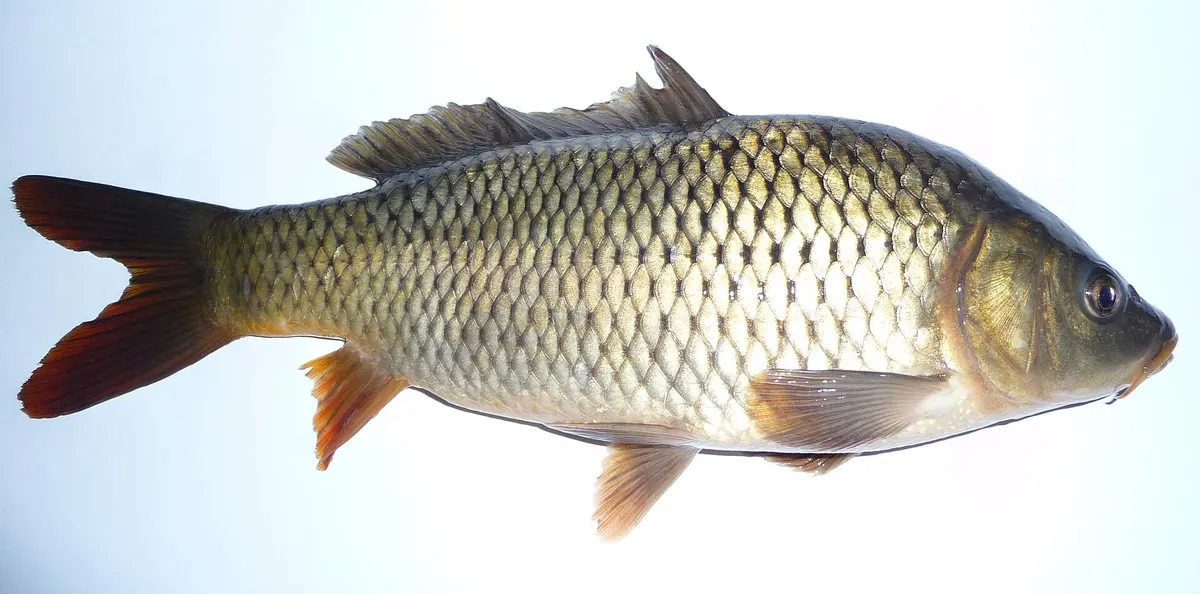
A fully scaled common carp on a white background
Photo: George Chernilevsky Β· CC BY-SA 3.0
Typical size
3 lb – 15 lb on commercials
A good one
20 lb (30 lb+ is a specimen)
Length
40 – 90 cm
Best time
Late spring to autumn

πŸ† British record: 68 lb 1 oz (30.875 kg), a mirror, Cranwell's Lake, Wasing Estate, Berkshire (2016)

How to spot it

Deep, powerful body with a long top fin and four whiskers (barbels) at the mouth: two at the corners and two smaller ones on the top lip.

Common carp are fully covered in neat bronze-gold scales. Mirror carp have a few large, scattered scales. Leather carp have almost none. They're all the same species. Crucian carp and goldfish have no barbels at all.

Where to find it

Commercial fisheries, lakes, gravel pits and estate lakes. Some rivers and canals hold them too.

In summer look near the surface on sunny days, in the margins, under overhanging trees, around lily pads and at the end of the wind. In winter they gather in deeper, sheltered water and move less.

Find waters near you

Feeding habits

Carp grub along the bottom for bloodworm, snails, shrimps and seeds, sucking up mouthfuls of silt and blowing out what they don't want. Signs they're feeding: patches of bubbles, clouded water and fish 'head and shouldering' out of the water.

They feed hardest in warm weather, from late spring to autumn, often early and late in the day.

Best time: Late spring to autumn. Warm, overcast days with a breeze are perfect. Dawn and dusk in hot weather.

Favourite baits

  • Pellets

    Hard pellets for feed; soft or banded pellets on the hook.

  • Sweetcorn

    Cheap, bright and loved by carp.

  • Boilies

    The go-to for bigger carp in bigger lakes.

  • Luncheon meat

  • Bread

    Floating crust on hot days.

  • Maggots and worms

How to catch it

Method feeder

Commercial fisheries

Rod
10–12 ft feeder rod
Reel
Fixed-spool (3000–4000)
Line
6–8 lb main line
Hook
Size 12–14, on a short 4 in hooklength
Bait
Hair-rigged or banded pellet, or a grain of corn

Squeeze damp micro-pellets or groundbait around the feeder and push the hookbait into the top. Cast to the same spot every few minutes and wait. Carp usually hook themselves and pull the rod round!

Hair rig with a lead

Bigger lakes and specimen fishing

Rod
12 ft rod, 2.75–3 lb test curve
Reel
Big-pit or baitrunner reel
Line
12–15 lb mono
Hook
Size 8–6 on a hair rig
Bait
Boilie or pop-up

Use a lead clip that lets the lead drop off if the line breaks. Bait up with a scatter of boilies, set your bite alarm and keep the baitrunner on so a fish can take line. You'll need a 42 in landing net and an unhooking mat.

Handling and rules

Big carp must go on a padded unhooking mat or cradle. Keep them low, wet them often and never stand up holding one. Most fisheries require a mat, a big landing net and antiseptic for the hook hole.

πŸ“œ Rules and seasons

On rivers, streams and drains in England and Wales there's a close season for coarse fish from 15 March to 15 June. Most lakes, ponds and canals are open all year, but check the water's own rules. Fisheries often have their own carp rules, such as no braid, no keepnets or barbless hooks only. Read the board at the gate.

Check the official rules on gov.uk

Watch: catching carp

Videos open on YouTube. We don't make them, but we think they're good.